
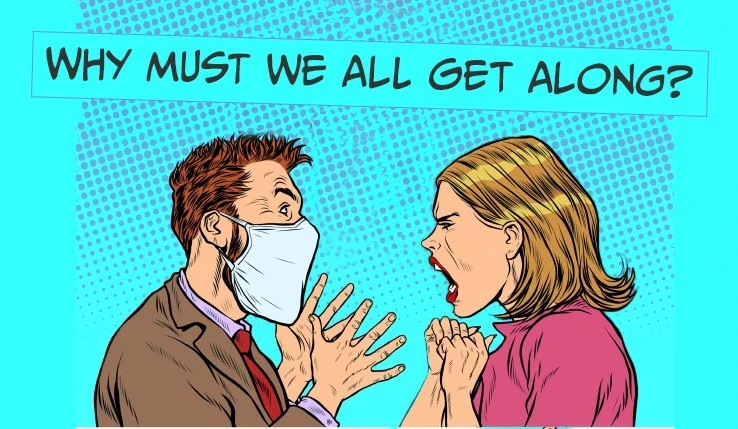
It seems like no one can stand disagreement anymore.
Actually, I shouldn’t say “anymore” because I don’t know if we ever really could.
Maybe we were always so fragile that we needed others to see the important things the same way we do. After all, I’m no historian, but I suspect that wars have been raged, probably many times, over differences of opinion about significant things (and, sadly, probably sometimes about insignificant things too).
Nowadays, it seems like many of these are cyber-wars and information-wars, waged in the theatre of social media and public opinion. These are the spaces where we express the impassioned views that might have once been aired in village councils, family meetings, within some actual physical community. We needed to find a way to make it work in that literal space. We should probably find a way to abide differences of belief in the virtual realm too.
I’m not claiming that it’s easy, and I’m not denying that people are talking about high-stakes stuff. Rather, my view is that
The stakes are high, but that doesn’t matter. We should be able to tolerate disagreement anyway.
Even with life-or-death stuff, actually.
I find it helpful to think at a level of immediacy, and move outward from there (a tip of the hat to my client who is studying Bronfenbrenner’s ecological theory). At the level of immediacy, I realize I must tolerate the differences of opinion that come up between me and my wife, if I am to maintain the deep respect I feel for her, and if I ask her to do the same. I also must accept and tolerate my mother’s opinions, even though they depart, at times dramatically, from mine. Moving outward, I know I must hear and respect the opinions of my professional peers--and by doing so, I’ve learned a ton (and disagreed with a ton). I rarely find myself bothered by the differences of opinion between myself and my clients-I have no expectation that they must think like I do.
But something weird happens when I shift the lens to the general public (as I perceive it, filtered through a bunch of clicks in online media).
I want everyone to agree with me.
But that’s a pretty limiting, and impossible, expectation.
I want them to agree with me about masks and vaccines. About climate change. About social justice and social repair. I want them to agree with me about the fundamentals of right and wrong, healthy and unhealthy. Somehow, they never do.
I mean, a lot of people do. But not all the people. And for some elusive reason, I think they should. I know I’m not the only one. In fact, this intolerance for differences of perspective seems to be the norm these days, leading to the inflammatory division of belief: right versus. left, conservative versus liberal, me versus you, and right versus wrong.
Is this a form of arrogance? Maybe. Is it a form of fragility–insecurity in our own beliefs (leading to the fear that if others disagree, this will shake the foundation of our epistemological systems, the roots of the belief and knowledge we hold–or think we hold–about the world and the way it works. If others disagree with me, it implies the inevitable fact that…I might be wrong.
Whatever the reason, whether vanity or fragility of conviction, the reality is ominous: we have become rigid and intolerant of difference in thought.
Try holding these questions for a moment: what if someone you love believes the opposite of you, even with respect to seemingly important things: politics, the greater good, the idea of right and wrong? Do you need to love them, or accept them, any less? Try to be honest with yourself – is difference of thought really a threat to you? Does it actually diminish you if someone else thinks you’re wrong?
How much energy do you really have to spare? How much of that energy do you want to spend on getting mad at the internet? There’s a very real cost to all this.